
Dear Friends of Fairview,
On rare occasions, events are significant enough that we think it’s worthwhile to update our investors with our views on them. We did so after COVID hit, and we do so now.
As opposed to dealing with a virus, I actually have a fair bit of knowledge in the area of American foreign policy and geopolitics. Though admittedly as a long time and avid observer, rather than an accredited professional (and haven’t they served us all so well?!).
You can be assured that I have deep and strong convictions on these matters, and a fully formed view of what my nation should be doing. I love America, and I want to see it succeed. I will however try my best to focus on what we think you need to know as our friends, and as an investor in the broad sense.
There are things I will say in here which might be uncomfortable for some, I can’t do anything but just analyze the situation. You will have AMPLE opportunity to see analysis contrary to mine, so I hope you can review what I write, and make up your own mind.
I will also note that we did not write you an update after the start of the “12-day war” last June, or after many other conflicts which have occurred…even including something as truly significant as the Ukraine war.
That we are writing to you today is a symbol of the importance we put on this moment.
Many terms we will use in this article are somewhat intuitive, but not well known, as they are terms of art in geopolitics. If you are not familiar with them, we want to introduce and define them for you — they will be in italics.
The Persian Empire
Iran views itself as a "civilizational state" — something broad and deep which is near a world unto itself, similar to China or India in its scale and complexity, while obviously smaller in population. They are nearly 100 million people who largely share a common history running back 5,000 years to the Elamite and Jiroft civilizations, and 2,500 years to the Persian Empire. Iran's very name derives from the ancient word Aryan — the Indo-Iranian peoples who settled the plateau around 1500 BCE. They certainly see themselves in the line of the Persian Empire, and that is nothing a people would ever relinquish. They understand they have a long and successful civilization, and an extensive and successful martial history.
They also understand they sit on one of the most important geostrategic pieces of land in the world, they sit on a hinge point of what Mackinder called “the world island,” the great Eurasian land mass where the majority of the world population and resources lie. Mackinder in his 1904 paper "The Geographical Pivot of History" — stated: "Who rules the Heartland commands the World-Island. Who rules the World-Island commands the World."
Iranians understand they sit on a geostrategic pot of gold, and many in the world have always wished to seize it. They have known this for a span of time that makes American history look like a recent footnote.
Iranians/Persians (who are not Arab I might add!) are a very intelligent and capable people. As one example, in the Ukraine War, Russia uses the Iranian made Shahed drone. It’s now licensed to Russia, and they cooperate on it. But it’s an Iranian invention. And it’s great for them because it’s CHEAP and effective, Iran can produce a lot of them, rumors are they have 80,000 and can produce 100 per month. Russia has a robust military industrial complex, they can produce their own ICBMs, nuclear warheads, etc., but they went to Iran for their drone technology. Iran largely designs and builds their own defense technologies.
Persia is a very complex and intricate society. There are many overlapping structures of power spanning politics and religion, counsels galore, etc. It is not Iraq under Saddam Hussein, the Sunni dictator ruling a primarily Shia population…take him out and there are serious issues for that regime. Granted there are ethnic differences in Iran, Kurds, Azeri, other smaller peoples. Once again it is still in some ways the Persian Empire—a Persian majority ruling various minorities. These groups can certainly be played against the Persian majority, but old empires like this have lasted because they were smart enough to protect small groups against other states not simply ruthlessly exploit them; our planners tend to exaggerate the level of tension that exists in these matters.
The word empire has become dirty. America does not want it applied to us; Russia does not either; but that is what Iran is. It is a shrunken but still basically coherent version of the Persian Empire; a Persian core that rules over other small nations within its borders, and those borders are as large as western Europe. This is distinguished from a nation state where nationality and statehood are purely aligned, such as Poland, or Japan.
A strong case can be made that Russia (another old land-based empire) is stronger today than before the Ukraine war—their military galvanized by a tough war they viewed as existential, new weapons and tactics innovated, old sclerotic ways shed. While it seems unlikely looking at the news today and our common assumptions, we risk reviving, rather than suppressing the Persian Empire.
The Recent History
I will not recount every event of the last 100 years involving Iran, but let’s say that there are significant grievances by both Americans and Iranians leading up to this day. Be assured that the grievances on the Iranian side are as deeply felt as any in America, and probably more far reaching in their scope.
Memories include recent wars such as the Iran-Iraq war which included America vigorously supporting their opponent. This was an incredibly brutal war fought on their soil. Right or wrong, you can imagine there are strong feelings about issues like this. I will also note Iran lost estimates ranging from 300,000 to 500,000 people in the Iran-Iraq war, that was not even remotely as big an existential threat as this; so they are not lacking a willingness to absorb losses.
Over the last approximately 30 years we have stated our intentions to do to Iran exactly what we see today. Not only did we make those intentions very clear, but we took real tangible action towards those goals. For instance, we invaded and fought tough wars in their neighbors to the east and west, Iraq and Afghanistan; from their view, this surrounding them for attack.
The Iranians watched, and they studied those wars intensely. I fully concede they were involved in those wars, funding proxies, supplying arms, doing all the things that empires sitting on geopolitical gold do; and in the process hurting and killing Americans, hence the legitimate grievances we have with them.
But we are here to analyze, not to moralize; investors need to look at reality, not moral narratives. The Iranian military for the last 30 years has had one goal: Prepare for the events which kicked off on Friday and are unfolding now. Prepare a system and a specific response for an American attack and regime change attempt.
There was no other mission than that. Many militaries in the world lack that kind of coherent strategic vision, I think you could say ours is included in that, by the very number of missions that are asked of it.
They watched us. They learned our weaknesses. And they built. They built a system designed exactly for us, and for the natural advantages they have.
America’s Position and the Nature of Wars
America is well known for having the greatest military in the world; I can say for sure it has the greatest military personnel in the world. And we are very grateful for their service.
We are unquestionably great at a lot of things. We have very well-formed nuclear doctrine and capabilities; when things reach the top rung of the escalation ladder we are well prepared.
On the other side of the barbell, we are by far the best in the world at special operations and what is generally called force projection — the ability to place and utilize military power anywhere on the globe. This ranges from 1980s operations in Panama to the more recent war in Afghanistan. While Afghanistan was a much bigger operation, it shares similarities based on the opponent and the mission.
These operations have been against what we would call a sub-peer opponent — a weak opponent lacking complex systems such as air defense, electronic warfare, advanced missiles, and air force assets. Or to the extent they had those systems, they were meaningfully inferior to ours.
A peer opponent is a Russia or China. Most strategic thinkers would grant them that designation; they have complex military systems that can challenge ours, and an economy, resource base, and industrial capacity to support them. If you don't want to see them as a peer, you can call them near-peer — but any suggestion they are lower than that is not serious. A near-peer opponent is for practical purposes as dangerous as a peer, and they are best avoided, as we have largely done since World War II.
These wars we fought with sub-peers were limited wars. For one thing, our opponent lacked the ability to make them more than limited. And our peer opponents did not see sufficient strategic reason to escalate them to a wider war—a war we would call a total war.
Panama was limited because they had no ability to make it much more. On the other side of the spectrum, Ukraine was also a limited war; it developed into that because two peer opponents (USA and Russia) fairly consciously decided it needed to be, because escalation of that war was too dangerous. Both opponents restrained the escalation ladder to remain below total war, though with notable moments of testing higher on the escalation ladder.
So, since World War II we generally have fought limited wars against sub-peer opponents. In these wars, we had the ability to stop at any time, we could pack up and go home, and eventually we did that in Vietnam, Iraq (mostly), Afghanistan, etc. We controlled not just the skies; we controlled the very existence of war or peace.
Both the American people, and even to some degree the American military, have a lack of understanding of the difference between limited war and total war. Many think they have seen war when they haven’t. Obviously, our officers understand it on an intellectual level, but I can’t imagine one really knows it until they experience it.
Our systems and assumptions will be deeply tested in a total war environment. As the architect and enforcer of the post-war international order, the assumptions of that order are likely dug deeply into our operations. Total war does not care about that order, or those assumptions.
Total war is a non-permissive environment; it’s the difference between placing an aircraft carrier off of Panama with little concern, or placing it off of Iran today with high performing missiles flying everywhere. Systems that work well in a permissive environment can seriously struggle in the non-permissive environment which total war brings. We are used to operating our carriers in a permissive environment.
The Middle of the Barbell
So, we have reviewed that the American military is absolutely world class at the two ends of the escalation ladder: nuclear deterrence and force projection. It is the middle of the barbell where there are questions. And those questions are persistent, well-documented, and bipartisan. I won’t spend space on naming them, but I can assure you there are a great many reports, wargames, etc. which point to the persistent difficulties I will discuss in this section. They are, however, not popular to mention.
This drift toward the barbell was in some ways the natural consequence of the role America had chosen — the enforcer of international order needs nuclear deterrence at one end and rapid force projection at the other, and that logic writes itself. Then came a generation of actual wars, limited wars against sub-peer opponents exactly as described above. And those wars turned the drift into explicit doctrine. Counterinsurgency — COIN — emerged as the dominant intellectual framework of the Iraq and Afghanistan era, most formally codified in the Army's 2006 Field Manual under General Petraeus.
COIN is precisely the barbell made into theory: the art of deploying limited, tailored force against a non-peer adversary, using special operations and intelligence rather than massed conventional firepower. A generation of officers were trained in it, promoted through it, and built careers around it. The middle of the barbell was not merely neglected — for a time, neglecting it had a theoretical justification.
The American military has been the enforcer of the international order. In order to do that America must pick the threat level necessary to deal with an affront to that order. You can’t just show up and nuke Panama. You must be able to match the force with the situation and, once engaged in the conflict, set the tone and the pace of the fight; that is known as escalation dominance.
We need a vector of forces we can choose from, and we need to be the one who acts, making others react to us. You can consider who is setting the tempo of this war from what you see in today’s news. The ability to accomplish dominance is tied up with high end conventional warfare. To visualize that concept, picture a World War II movie, updated with new equipment. Unrestricted total war conducted with the best available equipment, ample fighters, and lots of munitions, but short of nuclear war.
Our barbell approach has worked for a long time. We knew who the peer opponents were, and we could avoid conflict with peer opponents through nuclear deterrence and diplomacy. On the other side we have had the ability to “zap” any sub-peer parties we want in the world with force protection.
But what about all the middle? What about high-end conventional warfare backed by ample supplies of men, materials, and ammunition? Well, why would we need that? There are no near peer opponents other than the big boys I mentioned.
Plus, a lot of the ingredients of that are boring: Stacking up immense quantities of 155mm artillery shells? That is not as interesting as an amazing new weapon system whose manufacturing can be spread around to different congressional districts, and to different powerful companies, and that can please the dreams of a military man. We have struggled mightily to provide 155mm shells to Ukraine, that is well-documented and uncontroversial.
One could go on about this topic for a long time; picking up issues like how warfare has changed, and probably at least some legitimate reasons on how we got here. But it is my contention that this barbell approach is a major issue in the U.S. military. And it is best represented by magazine depth, this is essentially how long you can sustain high end conventional conflict with your ammunition stores.
War games for something like a defense of Taiwan show that we expend certain forms of crucial ammunition within a week. We produce 300 Tomahawk missiles per year. Iran produces 100 missiles per month, and reportedly 100 drones per month. Those are the drones that are hitting our bases and embassies right now at substantial distance from Iran; these are not toys.
On the other hand, our aircraft carrier naval group (that’s another long story we can avoid) is likely already running low on ammunition. Soon they will need to find a place to restore their stocks, they may have to take a week roundtrip to Diego Garcia, the remote island in the Indian Ocean. We are shipping these munitions from all around the world right now; allies such as Korea will be disappointed their missile stocks are being reduced.
One possible reason to not build out magazine depth in order to excel at high end conventional warfare is because someone like Iran, who apparently we need to control, is not considered a peer opponent, or anything close to it.
The question today is, are they a peer opponent? They definitely are not if they were trying to conquer Mexico right next to us. But are they a peer opponent while burrowed into the massive mountains of Persia? I think they are at least near-peer. And we will propose that being near-peer and just surviving is enough.
The Missile Robot and the Dead Hand
We know that Iran studied us intensely, up close and personal. That process formed heavily during Desert Storm; they saw Iraq’s traditional fixed and exposed mobile military assets get destroyed fairly easily.
Your formation of tanks? Gone. Your fixed missile launchers? Gone. Your airfields? Unusable.
Instead, they would plan for asymmetric warfare, with a focus on mobile assets and underground storage. They would practice guerrilla warfare but with advance technology and tactics.
They also engaged very deeply in a missile program, with an emphasis on cheap, effective missiles and drones. There are multiple different missiles for different purposes, many of them are quite innovative. But a huge emphasis was put on quantity, on magazine depth; to win a war, they would need lots of missiles and drones.
And they need to store those missiles protected underground. And they need to be able to produce more missiles and drones, underground.
Essentially the Iranians built a massive network of tunnels and underground areas that contain handling, firing and even building missile, and drones. They dart out of the tunnel, fire a missile from a relatively humble truck, and go back inside. And actually, there is now evidence they don’t need the mobile launcher…the missile just fires in place from under of a small layer of dirt, cannot been seen beforehand.
It’s a massive hidden machine that fires missiles: a Missile Robot.
And that robot is meant to FIRE, FIRE, FIRE. Constant stream, do not give your enemy a chance to breathe. During the 12-day war they fired volleys at night, because that was limited war, that was sending a message. Their total war plan instead is constant fire, never let up. That is a situation that can make our military’s job very difficult. I would note that since the first days of the war they have moderated the volume a little; that is a normal development as they settle in for a long war. Air defenses have been weakened and so they need fewer missiles.
Another big lesson they learned is that their enemy would use decapitation strikes; that would be a huge emphasis of their opponent. And of course we saw this as a primary goal of America to start the war. They knew they must have an extremely rugged system that not only can replace leadership, but carry on essentially without leadership.
While I don’t think Iran is leaderless today, it is a system that is setup to run essentially without a leader. These tunnels are connected in ways, but they are also independent; they have what they need to do their job alone for a substantial time period.
Cut off the missile robot’s head? Its arm will shoot. Cut off its arm, its leg will shoot. Eventually, its last toe will shoot.
I believe that everything I have written above is as fact-based as possible; the following proposition is my conjecture from the logic of the system and from what we have seen of it in the opening days of this war. That proposition is that the Missile Robot is capable of running on as close to automatic as possible, and while I do believe Iranian leadership exists and is in control, that the system by its nature is running somewhat automatically—and that the more it gets hurt, the more the robot runs on “auto mode.”
This “automatic” state, regardless of the level of damage the system has endured, is also backed up by history and by advanced theory and can bring advantages for Iran.
Thomas Schelling, Nobel economist & arms control theorist had a key insight: In conflict, the side that can credibly commit to not stopping gains enormous coercive power. If your enemy believes you will negotiate, they have an incentive to keep pressure on to improve terms. If your enemy believes you genuinely CANNOT stop, the calculus flips — they have to either destroy you completely or find an off-ramp themselves.
We can look for some evidence of this positioning. This man is the current leader of Iran and he makes it quite clear that there will be no negotiations:
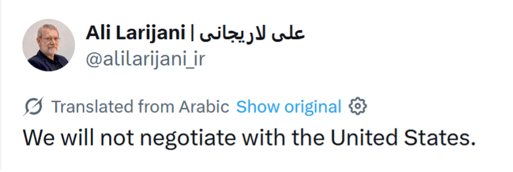
The Soviets had the Dead Hand, an actual automatic missile launcher that would fire when its trigger was destroyed. While this Missile Robot is different, the Iranians have certainly worked elements of this into their system, because:
-
Once they enter Total War, they do not want political distractions. And they want to maintain all the benefits which Schelling laid out. A fundamental stance that says “our system is not allowed to stop until it achieves its objectives” is a stronger system. And once they are in total war, that is all they care about; and,
-
They actually need the redundancy of a Dead Hand system, dispersed through all the tunnels of their system, because their opponent is ultra-focused on leadership destruction. Iranian leadership has confirmed the system is built this way.
There is a deeper wisdom embedded in the design of the Missile Robot that deserves recognition. Iran is a complex society — overlapping power centers, religious authority, Revolutionary Guard, political factions, competing voices. In peacetime, that complexity is a feature, producing resilience through redundancy. Under the shock of total war, with communications disrupted—leadership dead or hiding—and decisions needing to be made in minutes, that same complexity becomes a liability. Committees do not fight wars well. Factions do not fire missiles on a coordinated schedule. Deliberation kills speed.
The Iranians were sophisticated enough to know this about themselves. The Dead Hand is not an admission of weakness — it is the opposite. It is the highest form of strategic pre-commitment. Their best minds, sitting in rooms years ago with full information and clear heads, made the decisions that needed to be made. They built those decisions into the architecture of the system and removed the option of revisiting them under pressure. The ancient wisdom — know thyself — applied to military doctrine.
They said to themselves: We are smart enough to know that under decapitation strikes, under the psychological shock of American firepower, under the fog of total war, we will not be our best selves. So, our best selves decided for us, in advance, and permanently.
The philosopher Schelling understood this dynamic precisely: The side that can credibly commit to not stopping gains enormous coercive power. The Missile Robot does not deliberate. It does not negotiate. It does not lose its nerve. It fires.
The logic of the Missile Robot and the Dead Hand make for a very difficult situation; such a difficult situation that we decided to write this piece.
The Current Situation
On Friday February 27th America launched decapitation missile strikes on Iranian leadership, which were generally very successful in their immediate goal. That step was an automatic trigger for the Iranian State to turn on the Missile Robot. It signified the move from a political regime to a military regime operating under a total war footing with a plan they had worked on for 20 years+.
At that point the Missile Robot started firing, and in under an hour it was striking high-value American military targets across the Middle East—in a likely predetermined sequence, and breaking through every limited war standard that had existed in conflicts like the 12-day war. The Washington Post has reported that the Pentagon was very surprised at the extent and ferocity of the immediate attack; as usual these are unnamed sources, but I would not be surprised if that were true.
Immediately our military bases across the Middle East were hit, and hit hard. The home of the Fifth Fleet is in Bahrain. It is an absolutely massive military base that was a focus of strikes. It’s essentially a city, representing all the tools available to our military. Of particular interest to the Iranians are radar and similar signal assets. Now at four days in, there is very limited ability to defend this base. What air defense it had is largely expended, and if it is not, it will be soon.
No longer does Iran need to use expensive or complex missiles to assault this base. They are free to use cheap and plentiful Shahed drones to enact the destruction they want. And that is what they do, every day. What is still standing will be gone soon. We have radar systems in these locations upon which our regional air defenses rely that appear to have been destroyed — one of these systems takes about $1 billion to build, and we have 10 of them worldwide.
The U.S. military is resilient and highly adaptable, and they have other solutions to lost radars (plane-based). But these are the positions total war with a near peer forces you into — positions they never faced in Iraq or Afghanistan. In those limited wars, regional bases were calm operating hubs, where you ran signals technology and did support work for troops in theater. Now they are part of the theater in a Total War. It is a world apart.
By the fourth day of the war, the Iranians were sending drones into our embassies throughout the Middle East. This sounds brutal, our limited war mindset recoils at the idea. The Missile Robot operating its Total War mission does not care about such niceties. American command and control can be hiding out in them; they must be destroyed.
One interesting thing that happened in a place like Bahrain was that we housed military personnel in hotels, CIA officers in office buildings, and various staff at private ports. Iran had good intelligence and targeted all those people with drones etc., considering them legitimate targets in a total war contest. I believe this is part of the significant shock which the Washington Post noted. Within hours of our first strike, it seems very possible that a “in the rear with the gear” war planner-type might have been the victim of a drone or missile strike, in an office or hotel in Bahrain or UAE.
A possible scene looks like this: 10 CIA agents are working on a floor of a normal office building. The floor of that office building is all of a sudden destroyed by a drone within hours of our attack. That’s a shock.
But this process has made quite a mess in Dubai! As you might have noted. The desirability of having an American base in your country has really plummeted. And this situation has the potential to reach the level of significant political scandal. Unfortunately, I don’t think the news on it will be pretty. The political ramifications at home and abroad are too numerous to count in this short article; just believe me they are coming.
Meanwhile, of course, America has been striking Iran. No doubt they have been doing damage. No doubt they have more serious munitions planned that will do heavy damage. At the same time, we are often bombing Tehran; one building was reportedly their intelligence headquarters that strikes me as from 1972 or whatever. Does anyone think that building contains high value assets at this moment? I don’t.
Understand that when you see a video of Tehran absolutely exploding, that is not necessarily America achieving meaningful strategic goals. Tehran is not the linchpin of their military success. It certainly contains strategic assets, but as we have discussed, many of those are very decentralized throughout the country and hardened. It plays well to hit it, and it has a psychological effect—though every study of bombing shows it has a negative effect as far as American goals, unifying people and hardening their resolve.
Part of why they may be hitting that building, rather than others, is because so much of Iran’s military infrastructure is severely hardened. It is dug deep in the mountains, and dispersed. The American military needs to bring airplane-based bombing into the picture to deal with that. Missiles have small payloads relative to what a B-2 or B-52 bomber can deliver. Bombers can cause more damage. And it should be noted that Iran is at a significant disadvantage in that they do not have this airplane capability. For various reasons of history, they decided to not spend resources on it, and they were correct to do so.
Plane-based bombing is helped if they take control of the skies over Iran, which America may already have done, or will be able to do soon. But you must remember, like everything that Iran does, air defense will be asymmetric. It will sit and wait, in some remote mountain tunnel, then at the appropriate moment it will turn on its radar (opening it up to discovery) and take action. It will be guerrilla warfare, but with high technology. They will keep in the mind of their opponent that “you can try, and you can even succeed, but you will never not worry."
B2 stealth bombers are designed to not need clean skies, They don’t need the enemy’s air defense to be fully suppressed. The implementation of that design has not been robustly tested. There are examples, like Libya in 2011 or Serbia back in 1999. These were old systems that do not match what Iran has built, which is a generational leap beyond them. We will see how the strategic bombers perform, this will be a major test for them that you can look out for; they will be key to American success.
But the bigger issue is back to magazine capacity. Iran knows they will take big blows, and it will be painful. They built a system to absorb them and survive; we will see if it works. America needs to cause lasting strategic damage to them over the next couple months. After that, they will run into serious magazine depth problems. Various political actors have started to act like it is not an issue, but any serious analyst understands it is.
And this is to say nothing of how low we want to let our crucial stocks fall that support our other strategic interests such as defending Korea, Japan, Taiwan, Europe/Ukraine, and obviously our own country.
The American military was supposed to be making a “pivot to Asia” but we are now removing sophisticated military assets from Asia to bring to this theater. So, this war is already becoming a major drain on a very long held and planned strategic goal of American military and foreign policy.
The Road Ahead
We have some concerning conclusions from the logic provided above. I wish they were more positive, but I can only tell you what I think.
Iran is engaged in Irreversible Total War. Not negotiating is a critical part of that doctrine.
That this is Total War is a fact; whether it is Irreversible is the biggest assumption I make in this piece. I believe it is true; you can believe as you like. You should deeply consider that assertion yourself, because it is key to the most extreme ranges of my analysis.
Their system attempts to be a robot that keeps striking until it achieves its objectives or is destroyed. And it’s brutally hard to destroy. It is decentralized, even including command and control. Reportedly, there are entire systems of tunnels that have not even fired yet. America may not even know the location or anything about these; these are the multiple levels they will fall back to if needed.
What are their objectives? This is where it gets interesting and has broad implications. Obviously, I can only speculate. But with the scope and boldness of this response, my only conclusion can be that their goal is to drive us entirely from the Middle East. It is their goal that the base in Bahrain will be destroyed, and not be rebuilt, and the same with many other bases.
Certainly, the American military has a say on that. And will bravely defend their assets and presence in the region.
It’s likely that America and our allies will strike harder here soon and will do a substantial amount of damage to Iran. But as time goes on, magazine capacity is likely to catch up with us.
Iran may struggle to make hits for a period as more American assets are brought to bear, but they will still make hits—the lighter hits of a missile rather than a plane-based bomb. Those will accumulate. And they will not run into magazine capacity issues.
But what investors must understand is that the Missile Robot is not stopping. It is not capable of stopping. We hit GO on a very tough to kill destructo-robot in the center of the world.
So, whether it is the illness—us being driven out of the Middle East—or the cure—the American military preventing it—this is going to remain an exceptionally volatile situation.
Understand what this means: America is engaged in Total War with a Near Peer Opponent in the Middle East.
You think you have seen this before in your life, I am telling you that you have not. Keep returning to that if you wish to analyze these issues. This is different; this is entirely new.
Whatever the outcome here, this will have historic, world changing implications.There is a final asymmetry worth sitting with. America must win. Iran must survive. Those are not symmetric objectives, and history is unambiguous on which is harder to deny. Vietnam. The Soviet experience in Afghanistan, then ours. The Missile Robot does not need to defeat the American military. It needs to still be firing when America decides the cost exceeds the objective.
Iran’s base plan, stated simply, is survival. A system built into mountains over thirty years, designed to outlast the will of the most powerful military in history. That is a very achievable goal. And it is the one goal that does not require them to win a single battle.
While it will again be controversial, we will also consider if they have a bolder plan than survival.
The Financial Market Operating Assumptions
I wish I could relate this directly to advice, but that is difficult. I will say that the conclusions of the above lead me to believe:
-
This is absolutely not ending in some negotiated way, unless that is essentially America making a full withdrawal from the Middle East, which is impossible to even consider.
-
Things will get worse before they get better. There is a high likelihood you will see some shocking moments soon.
-
The market has not fully grasped this. Just today the market figured out this is not the 12-day war. They are still waiting to figure out just how much worse this is. And it is much, much worse.
-
-
The market has no concept right now of limited war vs total war. It assumes this is another post WWII limited war. It is not.
-
The market still bounces on little announcements of “secret negotiations.” Know that those are false. The Missile Robot is not capable of negotiations.
-
The Energy Weapon
It is worth discussing the Strait of Hormuz—the narrow and shallow entrance to the Persian Gulf. Inside the Persian Gulf lie vast amounts of the world's most critical energy infrastructure — the oil fields, terminals, pipelines, and liquefied natural gas facilities of Saudi Arabia, Kuwait, Iraq, the UAE, Qatar, and Iran itself. Roughly 20% of all global oil consumption and 20% of the world's LNG exports transit this single chokepoint daily, passing through a waterway at its narrowest just 21 miles wide. There is no meaningful alternative route for most of this volume.
Iran sits on the northern shore of the Strait in its entirety. They have spent decades placing missiles, mines, fast attack boats, and submarines along that coastline for exactly this moment. Closing Hormuz — or simply making it too dangerous for commercial shipping and insurance underwriters — is not a difficult military operation for Iran.
Again, we return to asymmetry: Iran does not need to universally control the strait; they simply need to cause chaos. If you hear that such and such capability has been removed from them, do not believe it. They have many, many layers to cause chaos: mines, drones, shore guns that have certainly not been destroyed by America because they can’t even be seen. If by some miracle all those were removed, they could drop 10 guys down there with shoulder fired missiles and easily take out tankers. And they will.
They don’t need to disable every boat; just getting 50% or even 10% is fine. The reality is they have gotten every ship that has tried, and of course they can do so. We struggle to protect our base in Bahrain; how will we protect a slow moving oil tanker? Or more so, 50 oil tankers. That is a turkey shoot for Shahed drones, or more likely naval drones.
It is my belief that the Strait of Hormuz is closed for the duration of this war. The only exception to that is China being allowed a hall pass through, but I don’t see that happening. It’s going to be a war zone, and China has other energy sources they can use.
The next, and maybe even bigger, issue is oil and gas infrastructure. Vast constructions to extract oil and gas lay across the Middle East. What took five years to build can be seriously crippled by 10 Shahed drones in a day. Asymmetry.
This is where the geopolitics enters again. The Gulf States (Saudi Arabia, UAE (Dubai!), Bahrain, Qatar, etc.) produce an immense amount of oil and natural gas. They also have been American allies (protectorates some might say) at some level, though they have always attempted to play both sides. As discussed earlier, they have American military assets located on their soil. While it looks indiscriminate on video, Iran has been judicious in what they have struck. If the U.S. military uses an asset, they strike it; the rest of the country they largely leave alone. At least that was what we observed on the first day of the war.
The Gulf States have been warned by Iran not to enter the war with offensive operations. They have been told that if they load up their jet fighters and send them towards Iran that will open all the military targets which Iran has on its total war target list; for the world economy that would most glaringly be the oil infrastructure. But the desalination water plants would be brutal for the people; they rely on those and would be a genuine humanitarian issue.
I suspect the Gulf States would love to stay out of using offensive warfare, but I am sure there is significant pressure for them to join in. Anyone telling you that they would be some kind of difference maker here is not serious. The most significant Gulf power is Saudi Arabia, and they struggled to make any serious progress against the Houthis guerrilla group over a decade.
But regardless of what the Gulf States want, it seems they will get dragged into this. And if they do, their energy infrastructure will get punished. And that may be a bigger, and more long-lasting impact than the Strait of Hormuz. Watch for escalation of attacks against Gulf State energy infrastructure.
It is worth understanding who gets hurt most by Hormuz closing, or Gulf energy infrastructure damage — and the answer is largely not America. The United States receives roughly 2.5% of Hormuz oil flows; we largely supply ourselves now. The pain lands in Asia. China, India, Japan, and South Korea together absorb 75% of everything that moves through that strait. South Korea is a useful example: they have built an impressive buffer of over 200 days of crude oil reserves, but their LNG supply — which runs their power grid — runs dry in two to four weeks. India is far more exposed, holding roughly 10 days of import cover. These are American allies and major trading partners.
If you look at my conclusions of the Strait of Hormuz closed for at least two months, and significant energy infrastructure damage, I think it’s impossible to not imagine significantly higher energy prices, even beyond their current levels. As I write this, I see that Qatar has shut in Natgas production; that takes two weeks to even restart.
Stocks Go Up???
There is a reasonable and well-documented argument that war is good for stocks. In limited wars fought since World War II — Korea, Vietnam, Gulf War, Iraq, Afghanistan — the data is fairly consistent. Markets dip in the uncertainty before conflict begins, then rally once the shooting starts and the uncertainty resolves into something priceable. Stocks rose more than 10% in the three months after the start of U.S. wars fought since the Gulf War. The logic is straightforward: American corporate earnings continued largely undisturbed because the fighting happened somewhere else. Hormuz stayed open, oil kept flowing, supply chains ran, and U.S. bases were calm rear-area logistics hubs. The S&P 500 is ultimately a measure of U.S. corporate earnings power, and in every one of those conflicts that earnings power was never seriously threatened.
World War II is the case most often cited for the proposition that even large wars are ultimately good for stocks. The S&P 500 returned 16.9% over the course of the entire war. But that number requires honest context. The United States didn't enter the war until December 1941—two years in—by which point American manufacturing was already the arsenal of the world. U.S. corporate earnings exploded precisely because the war was destroying everyone else's industrial capacity while leaving ours intact.
And while I have my doubts about a mega war rally, if it does come to be, it could be a different version of the above: While foreign countries economies’ will not be under bombing, they will be out of gas.
World War I is the more instructive analogy for sudden, unexpected escalation. The New York Stock Exchange closed entirely for four months in 1914 because they genuinely did not know how to price a world that had changed that fundamentally. Not a dip and recovery — a system admitting it had no model for what had just happened.
There is a further variable that the historical comfort ignores: valuation. The wars that produced the reassuring post-announcement rallies largely began from reasonable or depressed market valuations. The Gulf War started with the market at roughly 15x forward earnings. Iraq 2003 came after the dot-com crash had already taken significant air out of valuations. We enter this conflict from historically elevated levels — the market had been pricing in a remarkably benign future. The further you are from fair value when a shock arrives, the further you have to fall before you find a floor.
The honest conclusion is this: If this was a limited war — if Hormuz reopened quickly, if American corporate earnings were not materially disrupted, and if the rest of the world’s energy restriction created a relative advantage for U.S. equities — then the historical pattern might hold and markets could recover faster than fear suggests.
I have stated repeatedly that is a total war, and it has been since the moment the initial American strikes hit. So mine is not a bullish outlook for equities. As I finish editing this piece, the market seems to be validating this view.
Safe Have Assets
Similar to our view on stocks, things will not always be as they “should be.” We may say that these assets “should go up,” but they don’t for a while. But even if they are not immediately going up when you think they should go up, keep them in consideration. The two asset classes I will review are worth considering are Treasuries and gold.
Treasuries are the basis of our financial system still. You will hear all sorts of things about war being inflationary, blah, blah, the budget, blah, blah. We don’t see that as the prime mover. When panic hits, the financial system will need Treasuries.
You have $100 in your pocket? Ok that’s cash. You have $10k in the bank? Sure, the FDIC is good for it; that’s cash. Show me a billion dollars of cash? That does not exist. Yet people throw around the term, saying Warren Buffet holds $300 billion of cash. What they really mean is short term debt. These are the moments you want to hold the highest quality short term debt. Those are Treasuries. By the way, Buffett is smart enough to hold entirely Treasuries.
Treasuries will get bid hard. A 6-month T-bill is more cash than a bank deposit. When there are not enough 6-months to go around, the demand for the “moneyness” of Treasuries will move out the curve, increasing bond prices and driving downs yields.
They might bounce around, sell off, and do some odd things as the hedges and the positioning changes. But in the end, we are heading for lower yields—not because anyone cares about yields, but because a 1 year Treasury is more cash than a bank deposit for a large actor. Would you rather lose 2% of your purchasing power to inflation? Or 100% to a credit event? Obviously, you will eat that inflation loss and hold the currently risk free asset.
Of course, if you get into Treasuries early enough, you will make meaningful gains. The 5-year treasury would be an excellent place for conservative investors to sit. Moderate risk, but the chance for moderate gains of 10-20%. More aggressive actors could go for something like TLT, the ~20-year bond ETF, that could see gains of 50%+.
Gold is another asset that will be on minds. Fairview operates a gold fund that has done very well. We have thought long and hard on gold, what it is, and what it does.
We have said for years: Today gold trades on credit risk, not inflation. War is the ultimate credit risk; it severely severs credit relations. From private credit risk you can get .60, 40, 20 cents back on your dollar sometimes. From international credit risk, you get zero. And that zero was not on your speculative money—it was on your “cash” as a sovereign.
I could go through many, many examples over the last 20 years of gold moving on credit risk, and really not caring about inflation. I don’t have the space to cover them today. Go look at a chart and lay market history over it; you will see it. In the epoch we will transition to at some point in the near future, yes, it is likely to care greatly about inflation. But that is not its driving force today.
What is an example of international credit risk? Does Turkey “switch teams”? What happens to the holders of their debt with whom they are now belligerent? It goes away like a Russian Bank Reserve went away. I am not suggesting Turkey will do that. I am suggesting that is the kind of thing that happens in a moment like this. Does it make more sense that the Ottoman and Persian empires run the Middle East? Or that the middle part of North America does so?
Are the Gulf States wrenched painfully away from the west? Sounds extreme, but there are extreme things happening. Just another example of something that would sever innumerable credit relationships.
Remember: Gold is the only financial asset which is not someone else’s liability. In our new world, there will be unimaginable credit risks—ones that you never thought you would see.
That said, on occasion holders of gold access the liquidity they seek. Investors have been positioning in gold for two years. Now they can access its unique liquidity as they may need it now. It could dip on that basis.
When the dust settles, will there be inflation? Oh yeah. In the meantime, we can see sharp deflation of many assets, and inflation of certain others. Do not let deflation scares push you out of your gold holdings, or stop you from buying gold. Gold trades on credit risk in this epoch, end of story.
Can I say you should buy gold at today’s price for a trade? I can’t fully say that. It’s possible but not certain. Should you buy gold if it takes a 30-35% dip? You should sell your furniture and load up.
I will also note: Treasuries are a trade, if you get gains in them over the near term, you trade out; especially if you hold long duration bonds. That said, they may have a long way to run, more than one might think. But don’t hang out there forever; eventually longer term bonds will incur massive losses.
If you get a good position in gold, it’s a long-term hold. Five plus years at a minimum. If you have been surprised by gold so far, just you wait.
A New World
I have focused a lot on Iran, because it is wise to know your enemy. As you might have gathered, I do have serious concerns about the viability of achieving our strategic goals through military action.
But we don’t need to engage with the very basic idea of “win or lose” to imagine some world shaping new implications.
So what does the world look like on the other side? I think it looks very different. I think this will turn into an event which is deeply investigated by the American people, in a way that more minor events perhaps were not. To give some context, I believe this will frame the Iraq War as a “minor event.” And major changes to political systems, geopolitical relations, etc. will result.
We are in a position that we need to either obliterate Iran, or to leave the Middle East. That sort of titanic struggle will in itself have vast impacts on the global economy, and the emergent political systems. But you also cannot discount the possibility that leaving the Middle East is at least among the possible outcomes. There are vast implications there.
As to war duration: our base expectation is 2-3 months of intense, high-tempo fighting before the conflict settles into a different phase. That first phase is where magazine depth is tested most acutely: where oil infrastructure damage accumulates, and where the political will of all parties is measured. It is also the window in which markets will experience the most acute dislocations.
That said, do not anchor too firmly on the reasonable expectation. There is a reason we noted earlier that Persians are not Arabs: They do not boast. They did not announce the Shahed program until Russia was using it in Ukraine. They did not describe their tunnel network until they were confident in it. They let their actions speak. In the past week, Iranian leadership has made repeated statements that the world has not yet seen what they are capable of. That we will see amazing things. They are not a culture given to empty threat. When a Persian tells you something is coming, the history of this conflict — and of this civilization — suggests you should believe them. Our 2-3 month framework is the rational base case. A shock-the-world moment, something that resets every assumption, may come considerably sooner than that.
The 12-day war of June 2025 conditioned many observers to expect rapid resolution. This is not that. The Missile Robot was built for a sustained campaign, not a sprint, and the logic of the system pushes toward protracted conflict even if neither side consciously chooses it. The operation of the system for any length of time will have consequences that outlast the fighting itself by years.
Whatever the result, the old world is gone. Plan accordingly.
Nels Stemm